When I worked at the Alutiiq Museum and Archaeological Repository in Kodiak, Alaska, I experienced many unexpected events and learned many interesting things.
For example, one of my favorite days was when half the staff took time off to volunteer to harvest the inner skins, tendons, and meat of a magnificent Kodiak brown bear taken by the Alaska Wildlife Troopers. The local biologists with Alaska Dept. of Fish & Game were outstanding and understood the cultural and educational importance of not wasting the usable products found within the bear.
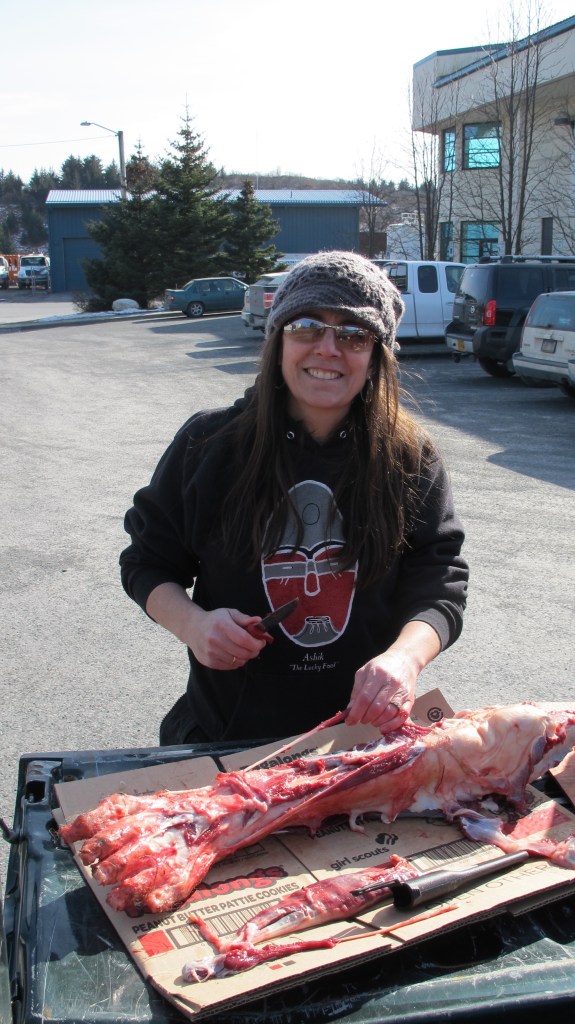
The first photograph is of me in the Alutiiq Museum parking lot using my bosses’ tailgate to harvest bear tendons to be processed into usable sinew. As you can see, a bear’s “foot” without the fur and claws looks just like a man’s foot. Having seen the bones of a bear in the wild I can tell you they look very much like a human hand. I gather from the Troopers that it isn’t uncommon for people to report bear bones as human remains – the similarities are remarkable.
The weather was cold the day this photo was taken and I cut myself a few times and didn’t even know it until my hands warmed. I later learned that the bear blood in my cuts could have carried all sort of nice things like meningitis. My husband just shakes his head.
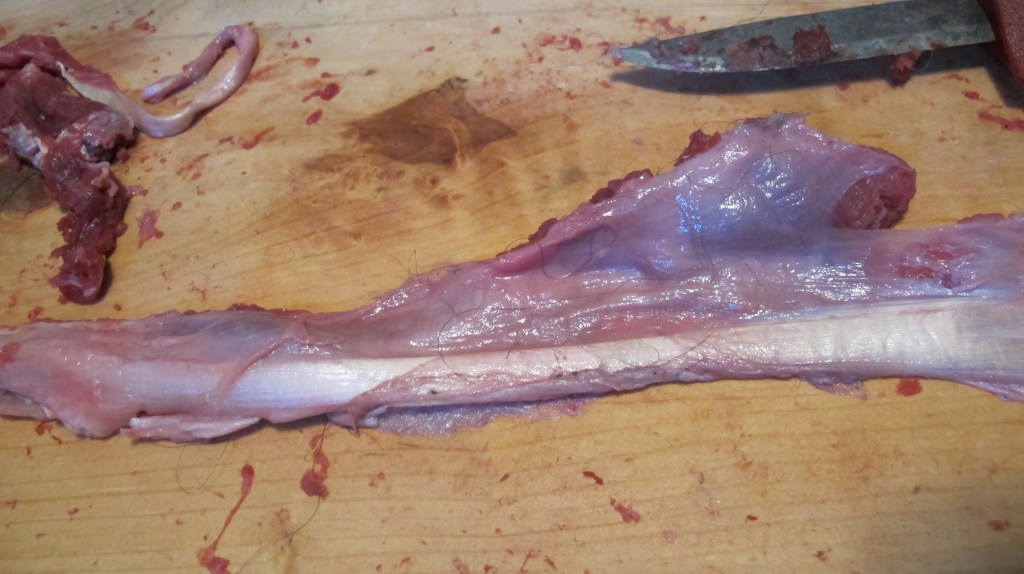
To harvest the tendons you pretty much find them and follow them, end to end, hoping to get the longest pieces possible. I decided to just get the tendons cut out and remove the horrible pesky sheath that covers the tendons in a nice warm place.
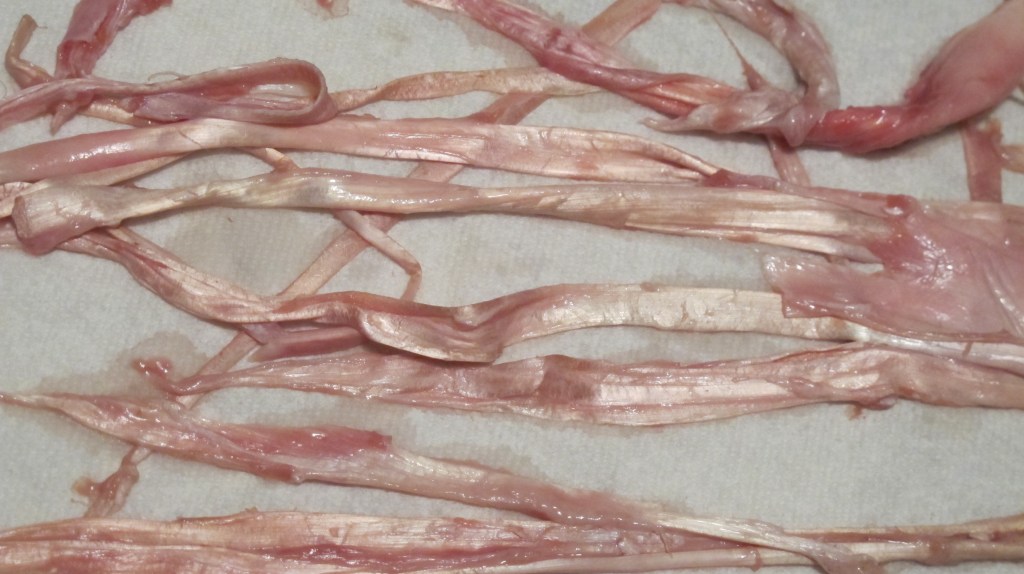
In the end, I never did figure out an easy way to remove the sheath – you just have to keep at it and eventually you will have a pile of lengths that look like bad beef jerky when dry.
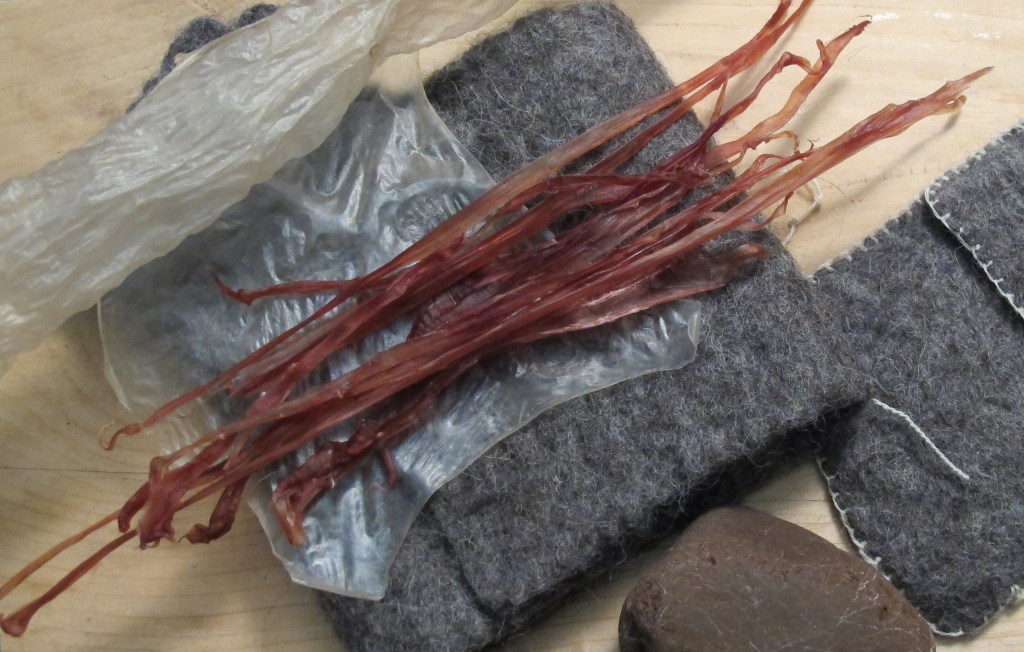
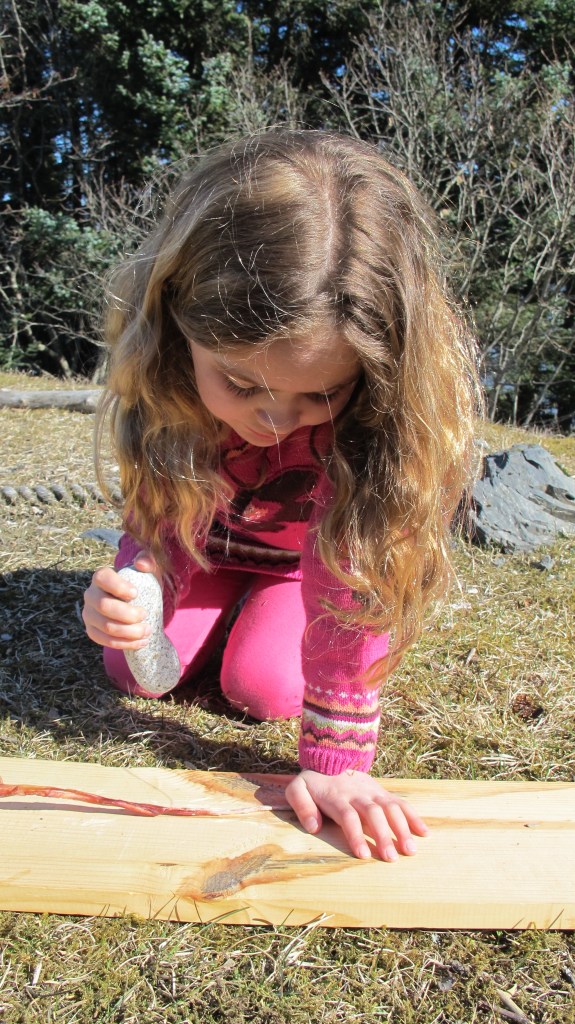
Once I had my pile of dried tendons I started the next stage by hammering a few with a piece of beach rounded granite that looked like a hammer stone. Hammering opens the long fibers and the color changes from red to yellowish off-white.
Next, I put the tendons in my mouth as those digestive juices really help the process of scraping off the extra meaty stuff that is between the long strands. Putting something like this in your mouth isn’t a big deal if you know exactly where it has been and who has handled it. Beyond that it doesn’t taste like anything.
Near the end, using my fingernails, I scraped the strands and eventually had workable lengths most of which were fairly short – less than 8 inches. Then I used the reverse twist method of making a two strand twine – or fine thread depending on my need.
This image shows a length of tendons processed to varying degrees to illustrate the different steps in making thread.
Thank you to Alutiiq skin sewer, Susan Malutin, for showing me how to separate the strands into twinable fiber.
© 2016 Jill HH Lipka. All rights reserved.
 JILL HH LIPKA